
What is beachheading in SEO? Why we win small keywords before big ones
Beachheading means winning lots of small, easy keywords first, then using that trust to take the big ones. Why our SEO plans start small, with real data.

Sometimes, our recommendations start off with keywords that look surprisingly small. That's beachheading, and it's how we build SEO plans: win a set of easy, highly relevant keywords first, prove to Google that people who land on your site are happy they did, and then use that trust to go after the big, competitive searches.
When we hand over an SEO plan, clients sometimes ask why we aren't going straight for the obvious, high-volume terms. The short version is that a site Google doesn't trust yet can't win those terms, and the fastest way to earn that trust is to win somewhere smaller first.
The short version: A beachhead strategy concentrates everything on one small, winnable market before expanding. In SEO, that means ranking first for lots of low-competition keywords closely tied to your business, then stepping up to broad national terms once Google trusts the site. In the UK, 14 small jeans keywords with a difficulty under 20 add up to 4,760 searches a month, more than "denim jeans" at difficulty 42 (Semrush, October 2026).
Where does the word beachhead come from?
A beachhead is a military term. It's the small strip of enemy shoreline an invading force captures after landing by sea, holds at all costs, and uses as a secure base to bring in heavy reinforcements, supplies and more troops before pushing inland. The most famous example is D-Day in June 1944, when the Allies landed on the beaches of Normandy.
The beachhead wasn't the goal. Nobody landed in Normandy to own a beach. But without that strip of sand, there was no way to get anything heavier ashore.
Business borrowed the idea. Geoffrey Moore's Crossing the Chasm built its whole market-entry strategy around the D-Day analogy: don't try to take an entire market at once. Pick one narrow segment, dominate it completely, then use that foothold to expand into the segments next to it.
So a beachhead is a way of fortifying your position before pushing further inland. That's exactly what we do with SEO.
Why can't a new website just go after the big keywords?
Because Google ranks you organically based on how much it trusts you, and a new site hasn't earned any trust yet. Google's own guidance on helpful content lists experience, expertise, authoritativeness and trust as the qualities its systems look for, and says plainly that "of these aspects, trust is most important" (Google Search Central).
Picture a new site with no authority trying to rank for "best phone cases UK". It's likely to have very little luck. Google doesn't know it yet, and it's a commercial intent keyword: one where an intrepid internet explorer is quite likely to spend money once they click through.
Think about that from Google's side. If it builds a reputation for sending people with their wallets out to sites where they have a bad experience, people stop trusting Google. So for searches where money is about to change hands, it leans heavily towards sites it already has good reason to believe in.
That's why E-E-A-T matters so much here. The higher Google regards your experience, expertise, authority and trust, the easier it gets to rank for the big potato keywords. And for a new site, the starting position is that Google has nothing to go on, good or bad.
Our SEO service is built around this, and if you're wondering why we don't start with the keyword list at all, why strategy comes before SEO covers the step before this one.
What does a beachhead look like in practice?
Say you're a fashion brand that wants to rank across the whole UK for "denim jeans". According to Semrush, that term gets around 4,400 searches a month in the UK and has a keyword difficulty of 42 (Semrush UK database, October 2026). Difficulty is Semrush's 0 to 100 estimate of how hard it is to reach the top ten, and 42 means you're up against established retailers with years of authority behind them.
Now narrow it down by location. A search like "jeans glasgow" gets far fewer searches, around 40 a month, but Semrush puts its difficulty at 0.
| Keyword (UK) | Monthly searches | Keyword difficulty |
|---|---|---|
| jeans | 74,000 | 43 |
| mens jeans | 40,500 | 44 |
| womens jeans | 12,100 | 51 |
| denim jeans | 4,400 | 42 |
| jeans glasgow | 40 | 0 |
Source: Semrush, UK database, pulled 30 October 2026.
Forty searches a month sounds tiny next to 4,400. But there's a lot less competition, it's far more likely we can get you ranking for it quickly, and the people searching it are local and ready to buy.
Why page one is the only place that counts
The big number is less impressive than it looks, because almost nobody clicks past page one. Backlinko's analysis of more than 12 million searches found that only 0.63% of Google searchers clicked on anything from the second page, while the number one result alone had a click-through rate of 27.6% (Backlinko, updated April 2025).
So ranking on page four for "denim jeans" gets you impressions, a number that looks lovely in a report, and close to no visitors. It doesn't matter how many people search for something if none of them ever see you. A first-page result in front of 40 buyers will bring in more customers than a page-four result in front of 4,400 people who'll never scroll that far.
That's the whole logic of a beachhead. Small keywords are where you can actually get onto page one, and page one is where the clicks are.
You never target just one small keyword
A beachhead is never a single search. Forty searches a month on its own won't change anyone's business, and we'd never build a plan around one term like that. What we're doing is gathering lots of small keywords together, each one easy to win, so that between them they add up to real demand.
Here's what that looks like for our fashion brand. Every one of these is about jeans, and every one has a keyword difficulty under 20, against 42 for "denim jeans":
| Keyword (UK) | Monthly searches | Keyword difficulty |
|---|---|---|
| jeans for short men | 880 | 12 |
| tall mens jeans | 590 | 17 |
| wide leg jeans womens | 480 | 18 |
| tapered jeans mens | 480 | 19 |
| organic cotton jeans | 390 | 15 |
| blue jeans for short guys | 390 | 9 |
| black selvedge jeans | 320 | 9 |
| made in uk jeans | 260 | 16 |
| british made jeans | 260 | 17 |
| how should jeans fit | 170 | 17 |
| 14 oz denim jeans | 170 | 8 |
| indigo denim jeans | 140 | 9 |
| sustainable jeans uk | 140 | 14 |
| mens jeans for big thighs | 90 | 0 |
| Total | 4,760 | all under 20 |
Source: Semrush, UK database, pulled 30 October 2026.
That's 4,760 searches a month, more than "denim jeans" gets on its own, from keywords that are each far easier to rank for. Add the local searches like "jeans glasgow" on top and the foundation gets bigger again. Some of them read a bit oddly ("blue jeans for short guys"), and that's fine. It's how people actually type, and the people typing them know exactly what they want. Notice that a few are questions, too. "How should jeans fit" is a guide, not a product page, and it still brings the right people to a jeans brand.
How the small keywords make you competitive for the big ones
This is where the foundation pays off. Every one of those keywords is about jeans. Rank for all of them and Google has seen, over and over, that your site is a good answer when somebody wants jeans. You've built your foundation.
So when you do go after a bigger term like "dark wash jeans" or "high waisted jeans", you're no longer a stranger turning up on Google's most competitive beach. You're the site that already wins most of the searches around it, with pages that already rank and people who've already clicked through and been happy. That's a much stronger position to compete from than a brand new page with nothing behind it.
Location is the easiest way to narrow a keyword, which is why it's the example everyone reaches for. It isn't the only one. A product niche, a specific fit, or a question your customers genuinely ask can all work as part of a beachhead, as long as each keyword is winnable and sits close to what you actually sell. If you're in a trade or a service business, our SEO by industry pages show what that looks like outside fashion.
How we beachhead, step by step
Here's the secret. It's four steps, and the order is the whole point.
Step one: pick keywords that are easy to rank for and heavily related to your brand. That might be because they're low volume, or because they're location-specific. Either way, they need to be close enough to what you sell that the person searching is a genuine potential customer.
Step two: give everyone who visits your site for those keywords the best experience possible. Fast pages, a clear answer, the product or service they were looking for, an obvious next step. The aim is for Google to collect as many positive signals as possible from how people interact with your site. Google says itself that it uses "aggregated and anonymised interaction data to assess whether search results are relevant to queries" (Google).
Step three: watch Google widen what you show up for. Over a couple of months, if people are happy with what they find, Google starts testing you on more searches. In Search Console, that shows up as impressions climbing and the list of queries you appear for getting longer, including ones you never deliberately targeted. That's Google telling you the foothold is holding.
Step four: start ramping up the size of your keywords. With the foundation sorted, you step up gradually rather than jumping straight to the biggest term on the list. Each rung you win makes the next one reachable. For the jeans brand, it might look like this:
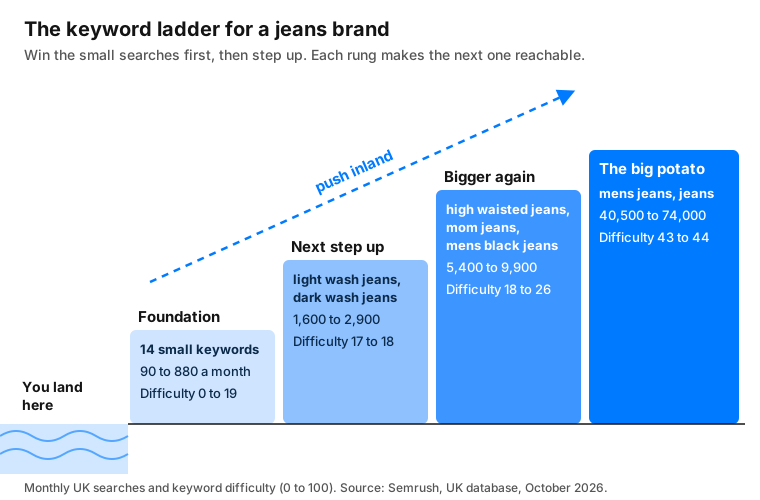
Every step works the same way as the beachhead did. Rank, give people a good experience, watch Google widen what you show up for, then move up again. By the time you're going for "mens jeans", you're pushing inland from a secure position, with a site Google has plenty of evidence to trust, rather than landing cold on the most heavily defended beach in the market.
If you want to know what happens to that ground once it's won, whether SEO keeps working after you stop paying picks up the story from here.
How do you know when to move inland?
The data tells you, not the calendar. We look for three things in Search Console before shifting the plan towards bigger terms: impressions rising steadily over several weeks, the number of distinct queries you appear for growing, and your average position on the beachhead keywords settling on page one.
If those aren't happening, the beachhead isn't secure yet, and the answer is to strengthen it, not to skip ahead. Going after "denim jeans" at a difficulty of 42 before Google trusts the site just means paying for content that sits on page five.
And plenty of businesses never need the big potato keywords at all. If a few dozen high-intent local or niche searches fill your diary or your order book, the beachhead might be most of the business, and the nationwide terms become a bonus rather than the plan.
Is it too late to start beachheading?
No, and there's never a bad time to start. Every site should have a foundation of small, winnable terms underneath it, however long it's been around. If you've only ever targeted the bigger search terms and they've never quite moved, the problem is often that there's nothing underneath them holding them up.
Adding the foundation now still works. Google doesn't penalise you for coming at it in the wrong order. You just start winning the smaller searches around your main topics, and the bigger pages you already have get more support from the site around them.
Small keywords still need a good page
None of this works on a weak page. Ranking for a small keyword gets you shown, but whether anyone clicks is down to your title and meta description, and whether they stay is down to the page itself.
That means a title that matches what the person searched for (Google's guidance on title links covers what it looks for), a meta description that tells them why your page is the one to pick (Google on snippets), and above all, a page that actually gives them what they came for. Step two only happens if the page is good. If people land, don't like it and leave, Google learns that too, and the beachhead never holds.
A real example: Shuffleboard.co.uk
We've run exactly this on Shuffleboard.co.uk, one of the three sites we built for Norfolk Boards. A lot of the searches the site was being shown for came from people who wanted table shuffleboard, the long indoor game. Norfolk Boards only sells the big floor version. Google was confused about who the site was for, so the people it sent often weren't customers.
Even the head term was part of the problem. "Shuffleboard" gets around 27,100 searches a month in the UK (Semrush, October 2026), and plenty of those people want a game the site doesn't sell. So rather than chasing it, we built up a portfolio of floor shuffleboard keywords. Each one was small. Semrush puts searches like "floor shuffleboard" and "outdoor shuffleboard" at 50 to 90 a month, with a difficulty of 0 to 16. Between them, they showed Google exactly who the site was for and what those people wanted to buy.
Over the 12 months to August 2026, the site's average position went from 31.6 to 12.2, monthly clicks rose from 109 to 265, and click-through rate went from 0.72% to 1.32%, according to the client's own Search Console data. It climbed every month from December to July, after our SEO work on the site had finished. That's what a secure beachhead looks like: the ground holds without anyone standing on it.
Why our SEO plans are built this way
So when a plan from us starts with keywords that look small, that's deliberate. Each one is a piece of ground we expect you to win, chosen because winning it makes the next, bigger piece easier to take. It's slower to look impressive in the first month and much quicker to produce rankings that actually bring in customers.
If you're weighing up the budget side, what SEO costs in the UK covers that. If you'd like a plan built this way for your business, have a look at how we approach SEO, or if you're based here, SEO in Glasgow. If you're not sure search is the right channel to put money into yet, Think First is where we work that out with you. Or send us your website and we'll show you which beach we'd land on first.
Frequently asked questions
What is a beachhead strategy?
A beachhead strategy is a way of entering a market by concentrating everything on one small, well-defined segment, winning it outright, and only then expanding into bigger or neighbouring markets. Geoffrey Moore made it famous in Crossing the Chasm, using the D-Day landings as the analogy. In SEO, the segment is a set of keywords you can realistically win.
Is beachheading only for local businesses?
No. Location is the easiest way to narrow a keyword, which is why it shows up in most examples, but it isn't the only one. A national brand can beachhead on a product niche, a specific question its customers ask, or a long-tail phrase with clear buying intent. What matters is that the keyword is winnable and genuinely close to what you sell.
How long before we start targeting the big keywords?
Usually a couple of months, but the data decides, not the calendar. We move inland when Search Console shows Google widening the range of searches you appear for and your impressions climbing. If that hasn't happened yet, the foothold isn't secure, and pushing for a keyword like "denim jeans" at a difficulty of 42 would be spending money on hope.
Doesn't targeting low-volume keywords waste the budget?
Not if they're the right ones, because you never target just one. Fourteen small jeans keywords, each with a difficulty under 20, add up to 4,760 searches a month in the UK, more than "denim jeans" alone (Semrush, October 2026). And since only 0.63% of searchers click anything on page two (Backlinko), winnable is worth more than big.
Can a brand new website rank for competitive keywords straight away?
Yes, but it's unreliable and very unlikely to be consistent. Across the board, we find it's pretty rare unless there's a significant budget and strategy behind it. Google ranks pages it trusts, and a new site hasn't given it much to go on yet, which is why we start with keywords where you can earn that trust quickly.
Is it too late to start beachheading if we've been targeting big keywords?
No. There's never a bad time to build a foundation of small, winnable terms, and every site should have one. If you've only targeted big search terms and they haven't moved, adding the smaller searches around them gives those bigger pages more support. Google doesn't penalise you for doing it in a different order.
Published 30 Oct 2026 · Updated 30 Oct 2026